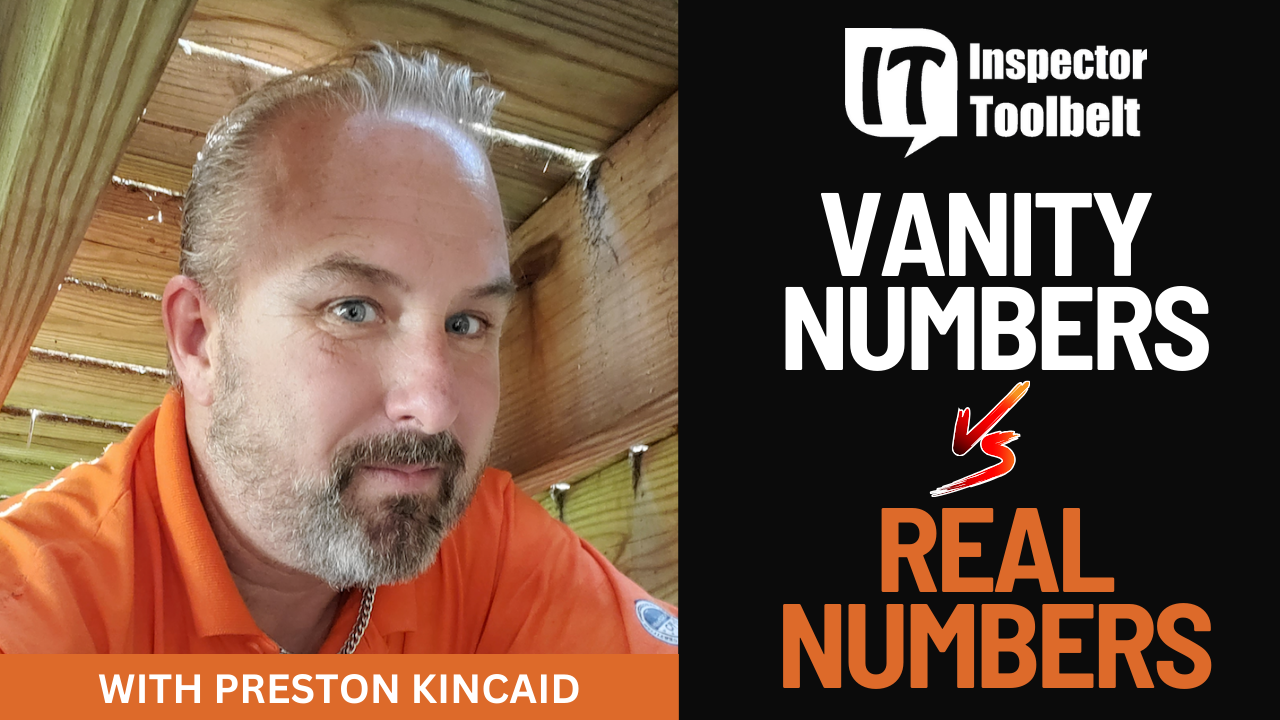
PRESTON KINCAID HIMSELF JOINS US TO DISCUSS “VANITY NUMBERS” & HOW WE SHOULD REALLY MEASURE SUCCESS – LISTEN IN!
FOLLOW OUR PODCAST






PODCAST TRANSCRIPT:
Ian R
Hey, Preston, welcome to the show.
Preston Kincaid
Hey, Ian, thanks for having me on, man.
Ian R
Nah, the pleasure is all mine. I’m really glad you made time to be on the show. And for everybody listening, today our guest is Preston Kincaid, who most of you probably know from the forums and Facebook pages, and you have a strong social media presence, you and a business partner of yours, AJ, and you guys just launched Best Inspector List, too. So wow, busy guy.
Preston Kincaid
Yeah, I’m excited about the list, it’s actually cool. Because if you know me, I love, I really, really love helping other inspectors. And, you know, it’s funny, because AJ and I were talking, we sit on these leads every day. And we were trying to figure out like, how do we connect all these people that ask us every day, how do we find an inspector, and we try to get him into the groups. And it’s so cumbersome and clunky that it’s impossible to actually connect social media leads with inspectors. So that’s where that list came from. And it just kind of took off, man, guys are getting inspections from it. I think AJ does all by himself.
Ian R
Yeah. And if I do my math correctly, between you and AJ, you guys have more of a social media following then the President of the United States. Yeah, well, you guys are doing something right. And, you know, we’re actually having you on the show today to talk about something that crossed both of our paths recently. And I thought it was a great topic. And it came about with a discussion because some people got actually, some upset and some upset in a good way, about a comment that Nick made on a previous podcast, Nick Gromicko, couple weeks ago, made the comment on a podcast, that he didn’t like low priced home inspectors. And you know, it’s not maybe how we would have expressed it. But I didn’t necessarily disagree with what Nick said, I’ve maybe not agree with how he said it. But it opened up a big discussion about vanity numbers, we say vanity numbers, because there’s a lot of things that we say in any part of our life, that makes us feel good about something. So we’re going to talk about vanity numbers today. And I wrote down, I wrote down a few here, Preston, and I mentioned to you before the show, and here’s what we mean by vanity numbers, how many inspections you do a year, that’s a big vanity number. I know lots of guys are like, there’s a guy in my service area, brags all the time. I still don’t know how he does it. But he does like six, 700 inspections a year by himself. And he brags about it. So okay, you know, how many inspectors work for you, how large your service area is, guys bragging about, oh, I served my entire state. Okay. How many types of tools you have, and how many weekends you work. The tool one is funny, I think that, I think that’s funny. And a couple of guys I know, they’re like, look at all these tools I have. And I’m like, okay, that’s like, that’s like not jumping in the ocean, but bragging about all your floatation devices. And, you know…
Preston Kincaid
I actually just cleaned out my car last weekend, after coming back from Arizona. And as I opened up one of my, my storage boxes, I realized how many tools I have that I never use. And when you realize how few tools you actually need to do a good thorough inspection, it’s kind of crazy to me when I actually started adding up all the math on those tools. And so I agree with you 100%. I think that there’s also some of the vanity around brands, right? Some of the guys believe that you have to spend a lot of money on really expensive tools. When the truth is you can get by with with, you know, very inexpensive tools for what we do as inspectors.
Ian R
Yeah, it’s very true. As a matter of fact, some of the best inspectors that I’ve ever met in my life came about well before thermal imaging and drones and stuff like that. And I’m thinking of one guy in particular that, you know, the young inspector in me is like, man, if that guy was ever on inspection with me, I’d be nervous, one of the few guys in the world that I wouldn’t be with. But these vanity numbers came about because the next comment because whenever we mentioned pricing, people start to freak out because we’re touching on a number that actually might affect us emotionally. And that is the bottom line number. Because Nick actually said show me, show me your bottom line on your taxes. Don’t tell me how many inspections you did show me the bottom line on your taxes. Don’t tell me how many inspectors you have. Tell me how much you made off of each one. Show me the real numbers. And that’s true. Those are real important numbers and not the vanity numbers that we like to brag about. And it comes about because like if we’re charging 250 a home inspection or 300 an inspection, we actually talked about this and you mentioned and we had a little discussion on one of the Facebook pages there, Facebook groups, and the numbers don’t add up. I actually put pulled out ZipRecruiter, I did the math, if you charge $300 an inspection, how much it cost you to do the inspection at the end of the year, you make about 25 to $27 an hour. My local Walmart warehouse on ZipRecruiter has an ad right now, warehouse worker starting pay $26 an hour with benefits. And it’s a great job, I have friends that work there, with benefits, with dental and vision and 401k.
Preston Kincaid
You know, the the pricing subject is, you know, I’m pretty, I’m pretty vocal about it, and I kind of beat that drum quite a bit. Because I’ll be honest with you, I’m frustrated right now, because I’ve hit, I’ve hit the pricing ceiling, right, every single inspector in my entire region, my whole cover, my whole service area that I cover there, they’re almost all priced somewhere between 325 and 450. And there’s one guy that’s 475 base rate for inspections. Now, that’s kind of a problem because we’re creating a perceived value ceiling, which means consumers and realtors, by and large, think that home inspection should cost between three and 400 bucks. Now, I’m kind of, you know, I’m bound by that same ceiling. And here I am, I have a $650 base rate. So I’m pushing the top of that ceiling as much as I possibly can. And over the last four years, I’ve fine tuned my per inspection average, which has come way up, it’s almost doubled. And so as we talk about these vanity numbers, this is where it gets really important to me, because in my second year of business, I just about worked myself to death, and I was burned out. And it was crazy. Because the end of the year, I think I made like maybe 110 or $120,000. Now at the time, I didn’t think that was terrible, I was like, yeah, it’s not bad. But that’s not, you don’t retire on that. That’s, you know, especially in today’s economy. That’s, that’s just living. And so what I wanted to try to do was price, I wanted to get more money out of what I was doing. And I wanted to do less, I wanted to work fewer weekends, I didn’t want to work my life away. We’re already working till late at night writing reports for God’s sake. So what I realized was that that ceiling that exists out there limits me. And I swear to you right now, I would literally charge $1,500 base rate, if I could. And I know there’s a lot of guys are gonna go, what, what are you talking about, 1500 bucks, that’s highway robbery. And yet, there are people in lots of different trades, lots of professions, there are business consultants that are charging, double, triple, quadruple that. And it really just boils down to us valuing ourselves enough as professionals to say, what is it actually worth when you help somebody make the biggest decision of their life, we’re all kind of anchoring, we’re kind of boat anchors to ourselves by keeping our prices down in this, in this realm. Because if I could just get my competitors in my area to raise their base rate by 200 bucks, I would raise mine by 300, I would go from 650, I would go up to 850, 950, I would push that ceiling. And if they raised their base rates to 1000, I would push mine up to 12 or 1300. But I’ve already figured out I can’t go higher than 650. And I’ve tried, that’s when you start getting the drop off, right. So I’m just pushing the bleeding edge of that pricing ceiling right now.
Ian R
So there’s a lot to unpack there, because the problem with it runs very deep and complicated. So we tend to look at it very simplistically, as an industry. Well, I need to make this amount of money. But your $1,500 is not far off from reality. So if we do the math of about $300 back in 1995 with inflation, cost of living. And I actually even use some examples recently of the cost of eggs is 2.8 times what it was in 1995. The cost of housing is three, I forget, it was like three point something times, I don’t have the math that I used in the other video in front of me. But now our inspection fee has only gone up by just a fraction, just about a little over $50 in the past 30 years. So we’re not talking, that guy brought up a point, he’s like, oh your price fixing. It’s not price fixing. It’s wanting a living wage for what we do. What we do is a heavy thing. So $1,500 is not out of the scope of imagination, just keeping up with inflation, not counting the elevation of our industry, more certifications, better tools, all this other stuff, is it would be a little over $1,000 for home inspection if we charged at the same rate as we did in the mid 90s. So it’s not, it’s not price gouging, and people are buying a $400,000 home but wanting a $250 home inspection.
Preston Kincaid
Right.
Ian R
They’re gonna get a $250 home inspection. Let’s just say that.
Preston Kincaid
And I think it merits mentioning, and I say this in my webinars, and I say this online as well. I think it’s one of the biggest and most common mistakes that inspectors make is assuming that people want cheap inspections. When I raised my prices, I got busier, and then I raised my prices again, I got busier. I went all the way up to a $650 base rate, which is right about where I started seeing a lot of drop offs. So I know that I’m teasing that edge. And so what does that tell you? That tells you that people want the best inspector, they’re looking for the best inspection, they want the most thorough person. And how they’re going to judge you is largely based upon your price and the perceived value they have in you. So there’s a lot of people that don’t want a cheap inspector.
Ian R
Well, that’s and that’s in every industry. Recently, I had a floor guy come in, I wanted to get my basement floor redone with some epoxy, and they grind it all down. It’s really cool to watch. I’m a huge nerd. But they came in and they presented it to me like, well, here’s a cheaper option. And here’s this and here’s that. And I’m like, I can’t exactly remember how I put it to the guy. I’m like, don’t talk about price right now. I want this floor to look cool. Show me the cool stuff. And he had to re-program himself, I could watch him, like, oh, he’s just not looking for the cheapest thing. If we walk in, we’re gonna get the cheap people. Then another guy came in bid the floor. And he didn’t mention price either. He showed me all the coolest stuff. And he goes, we only do high end floors. And I’m like, perfect. That’s awesome. That’s, that’s what I want a nice floor. Price was my second thought. I didn’t want to get gouged. But I also didn’t want to have the cheapest thing out there. So that assumption, it hurts our industry, that people want cheap. And that’s where we kind of need to redefine success when it comes to these vanity numbers. Because I know guys out there doing 200 inspections a year, making a little over $200,000 a year. And I know guys out there that are making less than $70,000 doing almost 500 inspections a year. So the first thing I hear when I say, are you doing well as a home inspector is oh man, yeah, we did 40 inspections this month. And I’m like, no, no, no, you don’t need to tell me your books. Are you doing well, because I could do 10 inspections and make as much as your 40, hypothetically. It’s about the bottom line. So how do you think we could reprogram ourselves to redefine success and not in vanity numbers like I did X amount of inspections. Instead, I made X amount of profit. Because that’s really why we’re in business not because you know we love, I love inspecting. I know you do. I like, I like meeting people. I like doing cool things. I like finding mummified rats in an attic. And it’s just fun. But at the end of the day, I do this to provide for my family.
Preston Kincaid
No, it’s true. I think that there’s a metric that a lot of inspectors ignore as well, which is the quality of life metric, right. So if you’re doing 500 inspections a year, and you’re working seven days a week, you’re not, your work isn’t supporting your life, your life is supporting your work, and you’re just working yourself to death. And I was there. By the end of my second year in business, I really had kind of a reality check where I just said, I like inspecting, and now I don’t anymore. Right. Into that year, I was just going man, I’m burned. Like I don’t even want to do this anymore. And I know I speak for a lot of inspectors who are there, you know, they’re, they’re kind of at that burnout point. And then I, when I kind of refactored how I looked at my business, and I really am struggling with the, I get a lot of, I get a lot of you know, I catch a lot of heat from inspectors because my whole mode right now is keeping things simple, keeping things simple. So it’s all about keeping my business as simple as possible with the fewest moving parts. This is why we argue about you know, radon, whether you use charcoal or CRM, it’s like great, I get all the features, but I’m keeping my life simple. And when I realized that I can fine tune, my sweet spot is 300 inspections. And I clear $250,000, I did a quarter of a million last year. So Nick Gromicko, when he heard me say that, he actually, when I had him on to do an interview, he pumped the brakes. He said you did what? I go, yeah, right now I’m at a quarter million in revenue, I’m comfortable with that, like that’s a good place to be. But I’ll be honest, man, if I can get people to raise their prices, I would do fewer inspections, and I would raise my prices, and I’d have a better life. Oh, and that’s a, that’s another, Ian, that’s another thing that a lot of guys don’t really acknowledge, every one of those inspectors that’s doing three or four inspections a day is taking two inspections away from another inspector. So by lowering your prices, you’re not only keeping the price ceiling low for everyone, but you’re, there’s also fewer inspections to go around. And I personally I want all inspectors to succeed and thrive and to do well. I’m not trying to put anybody out of business or hoard the work. And so I want to do fewer inspections, and I want to make more money. And I think that’s really the focus. That’s how you, that’s the metrics for success really, in my opinion.
Ian R
Yeah. And I think that’s really,, we need to change our mentality And, you know, these vanity metrics are happy little lies we tell ourselves, and some of the happy little lies that I hear us tell ourselves is, well, I like to give people value. I like to save people money, I like to give them a fantastic inspection for $250 because they’re good people buying a home. Okay, that’s all well and good. But let’s, let’s break down even from the outside angle, let’s say we’re that buyer, and we’ve lowered the ceiling of price. So somebody accused me of price fixing and saying we should raise our prices. And it happens every time I mention pricing. I’m like, I’m not price fixing. I’m saying we should charge a living wage, your price fixing by keeping the ceiling low. So now you’re forcing the rest of us to adapt to that. And I don’t compete with the cheap people. I know you don’t either. But it does affect the rest of the industry. So let’s talk about some logistics about it, so let’s say the guy charges $250 for an inspection. And he has to do four inspections a day. I know guys out there right now doing that. There’s a guy in my service area right now doing that. So now, four a day, how tired are you on each one of those inspections? You’re one human being? Are we really giving that person the best version of us? Did we really take our time? I like to stop. I love to open up the computer, look at each inspection before I go, like man, look at that ridgeline, something’s off with that, you know, this area has termites, let me go back to one of my old reports where I did the neighbor’s house. Yep, there’s termites. And then I go, and I look, and I spend time with them. If they need a little extra time, if there’s more issues, I dig in deeper, the whole nine yards. I can’t do that, to be perfectly frank, if I’m running around doing three to four inspections a day, and I’m a very experienced inspector, been doing this 20 years. So if you’re saying well, get better, I’m like, this is as good as I get man.
Preston Kincaid
So you also don’t make bake in enough time to do the things that actually helps your business grow. A lot of guys talk about the bottom line. But there’s also, there’s a lot to be said for top line growth. So there’s guys that are burning through the inspections and then having to do a lot of digital marketing and a lot of you know, pay per click stuff or whatever, email marketing, all this stuff to kind of keep churning the work. But to be honest, if they were doing fewer inspections and spending more time building relationships, more time talking with the realtors, you know, cracking jokes, having lunch, whatever. On Monday, I’m going to lunch with one of the managers of the largest realty group in the area. I couldn’t do that if I had four inspections on Monday. Right, but that one lunch is probably going to solidify the relationship with 37 agents. Right?
Ian R
And there’s a great point, it’s missed opportunity cost.
Preston Kincaid
Opportunity cost is almost never spoken about. I brought it up a few months ago. With, in relation to software, right, which I’m really looking forward to talking about, especially with Inspector Toolbelt as I get switched over. But opportunity cost is a big one, man. It’s like these guys buying this cheap software. And then they’re emailing the agreements and DocuSign over here and things like, there’s no possible way I could run my business that way. Because the opportunity cost was the more expensive. Your $50 software versus $100 software is costing you probably you know, 10s of 1000s of dollars every year because you’re rubbing sticks together to make fire.
Ian R
Yeah, missed opportunity cost is something, my brother’s a CPA. And he talks about it all the time because it’s an unquantifiable number. But it’s a number that everybody worries about. Because like your example of a missed opportunity, you’re running around, the agent is maybe new, but they’re going to do 10 more deals that that year, and you can’t take the time to talk to them because you’re off to the next inspection. That’s a missed opportunity cost that you can’t quantify. You didn’t spend the time with them. Even three inspections, and everybody has their own thing, but I am not. I don’t live in a city and maybe sometimes the city you can get three in a day and do okay. It’s not for me, because I do, I do the math. I’m like, okay, 45 minutes to my inspection, two and a half hours on the inspection, 45 minutes to my next inspection. And then you do that all day every day. Even if you’re only working five days a week. That’s a lot. I have a family, you know, and I just, I like them, so I want to spend time with them.
Preston Kincaid
Yeah, me too. I just got married two weeks ago. So..
Ian R
Congratulations.
Preston Kincaid
I’d like to spend some time with my new wife right, but my version of success to be honest with you is to do one inspection a day. That’s the max for me, I would like to work five days a week, do one inspection a day. And I’d like to clear a quarter million dollars, right. That’s really hard to do with the price ceiling being stuck where it is. And I’d like to talk a little bit about the psychology of it, because I think that’s an aspect that a lot of people don’t want to be honest about. And so I get asked a lot, why is it that a lot of home inspectors don’t want to raise their prices? It boils down to one thing and one thing only. And that’s fear.
Ian R
Yeah.
Preston Kincaid
It’s fear. So they’re afraid of losing work. And they don’t want to lose it to the next guy. And the fear is rampant, right. So what happens is new guys enter the business, and they’re afraid of not getting work. A lot of these guys gotta make it right, they got to put food on the table. So what do they do, they price themselves 50 bucks less than the next guy. Well, that downward trend has been prevalent for the last couple of decades. And I don’t think that fear is a success dynamic. That’s not a psychological dynamic that has ever led somebody to being very successful. How are the most successful people, you know, how do they operate? Usually, it’s confidence. Usually, it’s taking risks, you know, it’s being bold about things. And so I wish I could get people to just be less afraid.
Ian R
I think, since we’re talking about psychology, there comes a lot of what they call cognitive bias, which is a psychological term, it sounds like you already know what it is. It’s where basically we don’t understand enough about something, or know enough or have anything to compare it to, I think, is a better way to say it. So we create our own cognitive bias, should it be zero to 100? I have no idea. Where do I compare it to? So I’m going to put it at 47. And we’re just picking numbers out of the air. We do that with our own business, we have a cognitive bias because we’re sitting here and we’re like, okay, I know I can get work at $300. And this guy over here, charges $300. So we just go for it. And it’s a cognitive bias. We’re just going with our gut, basically, because we have nothing to compare it to. Whereas oftentimes, and I did that was when I first started out my first inspection business 20 years ago. But then once I met people, and they’re like, dude, you’re not charging enough, charge more. Okay. Yeah, here’s what I charge. Here’s how I charge and they taught me I’m like, cool, thank you. Now that cognitive bias isn’t a cognitive bias anymore. Now we have real information to go by. So fear keeps us at low numbers. And no matter what us top tier guys say, well, don’t compete with the cheap guys, we’re not competing with cheap guys, it does affect the market overall, though.
Preston Kincaid
That’s true.
Ian R
Now that we know when we have something to compare it to. It is no longer ignorance, it’s choice, we need to stop and pull ourselves out of it. And we can’t be afraid of the consequences.
Preston Kincaid
Yeah, you know, I think the the hurdle for me, and one of the reasons I kind of beat this drum a lot, and believe me, I take, I take my lumps for it. It’s, it’s not always good. But the thing is, is that the cognitive bias exists. But there’s also cognitive dissonance, which is, you can hold up this evidence to somebody, and there are some, you know, and I’m only going to mention his name, because he posted it in the group. And I loved it, because Chet Williams is one of those guys that for years, was charging a low number for his inspections. And he was saying, like, I’m busy all the time, right? And I was just harping on him on chat. You’re, you’re undervaluing yourself, raise your prices. And then he did and he got more work, like he got busier and was making more money and he started losing some inspections. So he started enjoying his life more. And here’s a guy going into his retirement years, who finally figured it out and said, you know, this nonsense Preston has been rambling about, there might actually be something to this. Because the cognitive dissonance makes us dismiss the evidence or the information that goes against what we currently think. Yeah, that cognitive bias is what we think in our head right now, our currently held belief is what we cling to. And when somebody like me comes along, and challenges that, it makes the brain feel uncomfortable, so they just dismiss me as a crackpot.
Ian R
You know, the, I think that was very well said, and you’re not a crackpot, that makes total sense to me, we get stuck in our own ways is another way to say it. And it’s nice that you mentioned that he started to lose work. And that’s, that’s something that we are afraid of, oh, lose work. I learned a long time ago, and I’ve said it in many other podcasts. My goal is to lose inspections. Every time I raise my prices, I don’t want to raise my prices, say raise them $50. I don’t want, I don’t want at the end of the week, to have the same number of inspections. I want to lose one. Because now I’m making the same amount and working less and enjoying life. So that’s a, that’s a very diminutive way to to say it. I mean, obviously, I don’t want to lose all my work, who would have a $5,000 inspection once at the beginning of the week, take the rest of the week off. But we want we want to lose work if we’re in that mode. If we’re doing 500 inspections a year burned out, we want to lose work, and the way to do that is to turn people down and just make less or make the same amount or it actually usually ends up being more because you almost never lose work. But raise your prices, and you’ll make a lot more. The other one, though, how many inspectors work for you? You had mentioned something about this before the show. I hate when guys brag about how many inspectors work for you. That’s a real vanity number. And there’s a guy that I know, we don’t, obviously never mention names. But he was just telling me he was having a hard time, mortgage is tight, this and that. And then I see him on the, on the forums, bragging about how many inspectors he has working for him. I’m like, that’s a, that’s a real vanity number, man. What are your thoughts on that, Preston?
Preston Kincaid
Well, first of all, you know, I think at our core, and we talked about the psychology around fear, I think underneath it all, we all want to matter, right? We all want to feel successful. And who knows what our background is, maybe some of us, our dads told us we’d never amount to anything or who knows. But at some point, all of us want to feel successful, like what we’re doing matters. And so to some people, I think those vanity numbers, you know, like, I got all these expensive tools, or I have 20 inspectors that work for me, or, you know, I’m doing 500 inspections a year, like all these vanity numbers, help to bolster kind of the outward appearance of success, right. And, for me, I got, I got caught up in some of that myself, you know, I was resisting being a multi inspector firm. But then I brought on a couple of guys. And it always sounds great. You know, yeah, I got two inspectors working for me, everything’s great, until you pack three schedules, and then one of them gets sick and gets Covid for a week. And now you’re, now you’re right, but you thought it was going to be easier having inspectors, now you’re doing three a day for seven days a week trying to catch up, right? So people don’t consider complication. Everything that you add to your business as a moving part, it triples complication. So for me, what I’m trying real hard to do in my business right now is just to keep it as simple as possible.
Ian R
And that’s a beautiful thing. I think that was very well said how you how you put it there. And we were talking earlier about the number in contracting, I have a contracting background. And my boss always used to say two or 20. And he was talking about employees. He goes when you have two employees, you have control, but you have help, one guy gets sick, other guy covers for him, one guy needs help, you help him, and you have control. Anything above two employees becomes complicated, a mess, you lose control, and you don’t really have the infrastructure to handle it. And then 20 and above, now, you’re big enough where you can absorb some of the problems. So I’ve always, I’ve always loved that, two or 20 rule. And that’s when you really become profitable, not only monetarily, but life wise, there’s a life expense to everything we do. And I think a lot of it comes down to hustle culture. You know, you have, unless you’re hustling so hard. If you’re not hustling so hard, it hurts, then you’re not working hard enough. And it’s like, well, okay. But I mean, if you have kids, I mean, don’t they need their mom or dad? If you have a marriage mate, and I’ll say it, I know too many guys that I’ve worked with and helped over the years, grow their business, go through divorces, and you know, all sorts of problems in life, because they’re like, oh, they say I’m working too much but what else am I supposed to do and providing for their future. I’m like, or is it a vanity number?
Preston Kincaid
Well, here’s, here’s a philosophy that I have, I’ll share with you, Ian. So almost every parent I know, raises their children to teach them about the value of money, being frugal, saving, pursuing a lucrative career so they can make good money and have a good life. And so we pretty much kind of raise our kids their whole life, to hold these values and to think these things. We teach them how to be responsible with money, pay your bills, have good credit. But the one thing that we, that I don’t see a lot, is we don’t really teach our kids that, number one, you’re born with only a certain amount of minutes. You only have a handful of minutes to live your life. And with all the money in the world, you can’t buy a single extra minute, but you can always make more money. And so we kind of prioritize financial success, financial security. You know, the money aspects are something that’s just kind of ingrained in us all through school. I mean, think about it, our first 12 years of school are all what, to prepare us for a job or a college career. But we we kind of tend to feel or act like we’re going to live forever. And then if we forget to live along the way, you can wake up and you can be missing decades of your life. I’ve been there. I remember, I remember thinking it was cool to do 100 hour weeks for years at a time, building a company. So you’re probably there now with, with Toolbelt. But you can wake up one day and just go man, I don’t even remember the last 10 years of my life, all I’ve done is work.
Ian R
Yeah, if you’re listening to this, you’re not listening to two people that don’t have experience in this, 100 hour weeks, one o’clock, two o’clock in the morning, falling asleep at your keyboard. Just working yourself to death. I’ve been there, you’ve been there. That’s not success. That’s, it’s being a slave to your business. So there’s two, there’s two numbers really, and they’re not really numbers, to determine whether we’re actually successful, the bottom line of what we make, and the time that it gives us in life, if our business is not giving us the bottom line, the net proceeds that we want, or it’s not giving us the hours back in our life that we want. We have not achieved success. Those are two ways to measure it. We’re measuring our success in the home inspection industry really, really wrong. And, you know, I’m not saying that being multi inspector is bad or anything like that, you know, obviously, it’s me. I’m just saying that, could we step back and say, okay, if we have 10 inspectors, okay, can I get a business manager? Can I make $80,000 less a year, but then take some time with my family? You’ve earned it. If we’re starting out, we’re charging $250 an inspection, and we’re doing all these inspections, can we raise our prices, do fewer inspections and have more time with our family? Those are the two metrics that I think would define it, time and our bottom line are net proceeds.
Preston Kincaid
I agree with every word you just said. I personally like to leave more inspections on the table for others. One of the metrics,Ian, that I like to measure myself with and I have, I’m telling you last four years, is how many people can I help? Like, that’s important to me, people talk to me all the time about my social media numbers. And now that’s growing and all that stuff. And I tell them all the time, I say, you know what number I’m most proud of is how many inspectors that I have relationships with, how many people have been through my jumpstart program, or messaged me daily with questions or come and shadow me for a few days, whatever. Like that actually means more to me. Why? Because when I’m dead, my social media numbers are going to dry up in 90 days, and people are going to quickly forget about me. But the people that I’ve helped grow their businesses and improve their lives, that’s like a residue of my life that I get to leave behind. And that matters more to me. And that’s, that’s also part of what I’m doing. It’s not just all about inspecting houses. I’m doing my retreat in June, right? Man, I got inspectors coming from all over the country, we hang out in the woods and fish in the stream and get to know each other on a personal basis. That’s meaningful. That’s a, that’s a metric for success. How many friends have you made in the business?
Ian R
Yeah, those are things that matter. You know, they matter in other industries, too. I mean, you think about like, like a doctor? Does he measure his metrics by, okay, I got 15 heart transplants in today. It’s like whoa, buddy, hang on. I want the doctor who is maybe doing three a day. Let’s, let’s back up. And, you know, there’s a doctor that I know. And he has up on his wall, all the thank you notes and everything that he’s ever received over the years. You know, does he make a good living? Yeah, he charges for it. He’s a doctor. But he, when he helps people, he feels good about it. You know, that is an important metric.
Preston Kincaid
I’m glad you brought up that analogy because I caught heat. My buddy Yuri the other day, gave me some heat over this is like, I wish you’d stop comparing us to doctors and lawyers. But you know what the truth is, the reason I do that isn’t because I think I’m a doctor, I think I’m a lawyer. But I do think that we are professional consultants. And if I can think of that, if I can think of the physician level or the surgeon level or the lawyer, I’m at least aiming high, right? Like, I want to elevate what we’re doing. Our entire profession, I want to help elevate, I want all of us to be thought of in higher regard. Instead of being stuck in the contractor mindset or service provider, or whatever, you know, yes, part of our job is crawling around on the dirt and crawl spaces. But at the end of the day, the most important thing that we do is consulting with our clients. We inspect the house, that’s half of it, but we got to be able to communicate that to somebody, give them advice, give them recommendations, and that’s what they’re paying for. And if we can start to think of ourselves at a higher, higher regard, have a higher professional esteem. That’s how we kind of raise the, raise the tide for everybody, right. And so when you need a heart transplant, to use your analogy, you don’t shop around for the cheapest doctor, because that’s an important life thing. You know, your heart. So when you’re buying a house, you’re not shopping around for the cheapest inspector unless you buy and, you know, unless you’re buying a trash house or you know, you’re broke. But at the end of the day, those aren’t the clients I want anyway.
Ian R
Yep. It’s like, I still remember the time that I saw Groupon one time, or maybe it was just a regular coupon for $50 off of lasik surgery. And I remember standing there and looking at my wife and saying, with somebody with a laser in my eye, the last thing I want to do is hand them a coupon. I’m like, here’s extra money. So there’s a lot to unpack there. Because when it comes down to it, the doctor analogy, lawyer analogy, engineer, architect, none of those analogies are far off base. We need to understand even though we’re not code inspectors, we need to understand what was code back then compared to now, why does, why does this look wrong? We need to understand multiple disciplines, we need to have very good people skills, we need to have good writing skills, we need to have all the skills that engineers, architects, attorneys, doctors and all that stuff need. If you were to pile the books, and all the InterNACHI courses on every aspect of a house, in one big warehouse, I would imagine it would be as big or bigger than any one of those other professions that we just mentioned.
Preston Kincaid
I completely agree, I caught, I caught heat a while back for making the comparison, I actually made a statement that said, I actually think that my job is harder than a lot of lawyers. And the funny thing is a close friend of mine, a business partner, and two of my lawyers I spend a lot of time with, Charlie Cochran out of California, a good friend of mine, he’s a business partner in my tech company. And I’ve hung out with him and other lawyers before, and he just kind of go, these guys will tell you straight up, like, Charlie talked me out of being a lawyer, because you goes, you don’t want to do my job, I basically sit behind my desk and listen to people tell the same stories over and over again. And yet, this guy’s charging, you know, $1,500 an hour, right? And I’m going okay, what he’s doing isn’t that hard, they push papers around, and most of the stuff settled out of court, like it isn’t like they’re, you know, in front of the judge every day litigating in court. So we have to always be learning, always constantly, we have to connect the dots, like our job is a lot of brain work.
Ian R
It is. And it’s a lot of bookwork. So, and the problem is, when we don’t charge accordingly, we’re like, well, how do I put this, when we don’t charge accordingly, we diminish, we diminish our, our industry to something less than it is. There’s a reason, there’s a reason why home inspectors, sometimes we have a bad name. Builders will make fun of us and all all that other stuff, you know, there’s a doctor that I know. And he says he takes about a month total, if you accumulated through the year, just to keep up with changes in the medical industry. He goes, there’s days of the week where I don’t see any patients, I just study to just to keep up. Now sometimes we do that in the slow season. But if we’re cranking $250, inspections, $300 inspections, are we really saying okay, I’ve made enough that I can take a full day off to keep up with the changes in the industry? What’s going on with closed cell insulation now or, you know, what, what are we doing with the hydrostatic pressure in this particular municipality, we miss out on a lot. We’re not keeping up with an industry that is highly complicated.
Preston Kincaid
I’ll be honest, I’ll be transparent when I’m, when I’m burned out, and I’m chunkin through two, three inspections. And I’m just trying to keep up yeah, you know, I do catch myself sometimes kind of just going through the motions and just checking the boxes, clicking the narratives. And there are times I have to pump the brakes and stop and go, wait a minute, maybe these things are related, right? Maybe there’s a kinetic chain happening here, maybe this is grade related, maybe this is the weight of the roof covering, causing these wall cracks, like and if, if I was just going 1000 miles an hour with my hair on fire, I wouldn’t have the time to stop and really think methodically about what I’m looking. Right. And I would imagine there’s a lot of inspectors out there that are just churning through it like, like a treadmill, or like a, you know, just like a process like a machine instead of really looking at every house and you know, reading it thoroughly, you know, and so I think that’s where a lot of it falls into, you know, the second most common comment that I get on social media, and I’m telling you, it’s, it’s by the 1000s, is people saying, I had a home inspection, and he didn’t catch this, this and this and this. I had, I paid a home inspector, and he missed all this, and I ended up having to you know, replace all this crap. So in my head, the first thing I think is well, you probably price shopped. Right, you’re probably that person that calls around to find the cheapest inspector you could. And that cheap inspector was doing four inspections that day. So what was he doing? He’s rushing through it. Right? So how do we elevate our whole industry? Number one, the price is kind of a core issue. Because if you’re not charging enough to really spend time absorbing everything in that house to figure out what’s going on, you’re just, you’re just crunching the numbers.
Ian R
And that, and that’s a fantastic point. So let’s say hypothetically, people, people balk at that $1,000 number, you know, our average inspection fee, at any given time is anywhere from 750 to $1,200 in my companies, so imagine if we had $1,000 to do an inspection, and we’re used to $300, that’s over three times as much. Would we feel comfortable then slowing down and just saying, what’s going on here? Like you just mentioned? Would we have the ability to do a better inspection to say, okay, I’m taking Friday off, because I need to go and just keep up with the latest changes in the inspection and construction industry and improve in my craft. And now people say, wow, that’s $1,000. People can’t afford that. So the average home is $400,000. So that is one quarter of 1% if I’m doing my math, right, so imagine we were buying a $400 tool, and somebody said, I am going to give you the best inspection of this tool, I’ll make sure everything works perfectly. You just give me a quarter. I throw him two. So it’s the same with an inspection.
Preston Kincaid
I would be willing to, you could throw it a date right now. And I would open up my software right now and flip it around, as long as we can blur out the names. And I’d be willing to bet you that any inspection on my calendar right now would be right there in line with yours anywhere between 750 bucks and 1500 bucks.
Ian R
Yeah.
Preston Kincaid
Right. Like that’s, that’s really right, that sweet spot average that I’m in because the 650 base rates also going to have ancillaries and everything else.
Ian R
Exactly.
Preston Kincaid
And then I hear these guys that are doing 275, 325. And I’m just going, you know, I have two and $3,000 days. Right? That’s a good day. I feel good about that. Would I feel good if I burned a 20 hour day and made 900 bucks. I rather go fishing.
Ian R
You and I are proof that it’s possible. And some guy told me it was like, well, you’ve been around a long time. How long have you been around, Preston?
Preston Kincaid
This is my fifth year.
Ian R
Yeah. So it’s not like you’re a 20 year veteran, you came in and you’re like, oh, I’m worth this. I’m gonna raise my prices. And we’re not too far from each other. It’s not like we’re from a wealthy, overly wealthy area where we can command crazy high prices.
Preston Kincaid
That’s kind of the funny thing is if you saw where I lived, feel free to look up Chenango County, it’s, I mean, there’s dueling banjos on every corner here, man. It’s economically depressed. This is not a, I mean, homes routinely are, you know, I’m inspecting $75,000 houses. 125 for good ones, right? I know people that are inspecting half million dollar homes, million dollar homes for 300 bucks.
Ian R
I don’t get that.
Preston Kincaid
I mean, it’s crazy.
Ian R
I’m not saying my area is economically depressed or anything. But my town has, the town I live in has 174 people. So like, I’m not, I’m not living in New York City charging New York City prices. So it’s not impossible. It’s just a matter, I think you brought out a good point, getting over the fear. And actually making the change, not just raising the prices for the sake of raising prices, raising prices and elevating our industry at the same time.
Preston Kincaid
I agree with 100%. For me, I wouldn’t feel, I wouldn’t feel good about doing, I didn’t feel good about doing three, sometimes even four inspections, because I knew that I was taking inspections away from other guys. I didn’t feel good about that. Like, I don’t need to do all the inspections. I want everybody to do well, I wish some of them would just kind of, you know, keep up a little bit on the pricing thing. You know, if they see me charging 650, can you guys just come up to 500 maybe? Because if you come up to 500, I’ll go to 750.
Ian R
Yeah, I wish more people would think about that and apply that. Not just think about it, but actually apply it. Because we talked about a lot of vanity numbers. If we’re, if we’re sitting around, and we thought about the vanity numbers of how many inspections we’ve done, or how many employees we have, or do we have employees and all this other stuff, stop and think, do we measure our metrics like that? Or do we measure it in the bottom line on our books and the time of our life that we get back? And as Preston mentioned, helping people, those are three important metrics that when we look at anybody who’s really quote unquote successful, they found, they found a balance between those three things. You know, it’s important. Preston, I couldn’t thank you enough for being on the show. I could go on for hours here. We’re running out of time, but we’re gonna have to have you on again. Maybe have you and AJ on both and talk about your, the Best Inspector List and how that service is helping inspectors and yeah, it was fantastic having you on. Thanks for sharing your wisdom.
Preston Kincaid
Hey, man, I appreciate it. I had a good time. We’ve been meaning to do this for a while. So thank you very much for the time and the opportunity.
Ian R
Yeah. If you ever have any thoughts or ideas, let us know. We’ll have you right back on the show.
Preston Kincaid
Alright, sounds great. Keep doing what you’re doing, man.
Ian R
You too. Thanks.
Outro: On behalf of myself, Ian, and the entire ITB team, thank you for listening to this episode of Inspector Toolbelt Talk. We also love hearing your feedback, so please drop us a line at [email protected].
If you’re enjoying the conversation, don’t forget to hit the subscribe button. Our podcast is available on all major podcast platforms. For more information on our services and our brand-new inspection app, please visit our website at Inspectortoolbelt.com.
*The views and opinions expressed in this podcast, and the guests on it, do not necessarily reflect the views and opinions of Inspector Toolbelt and its associates.