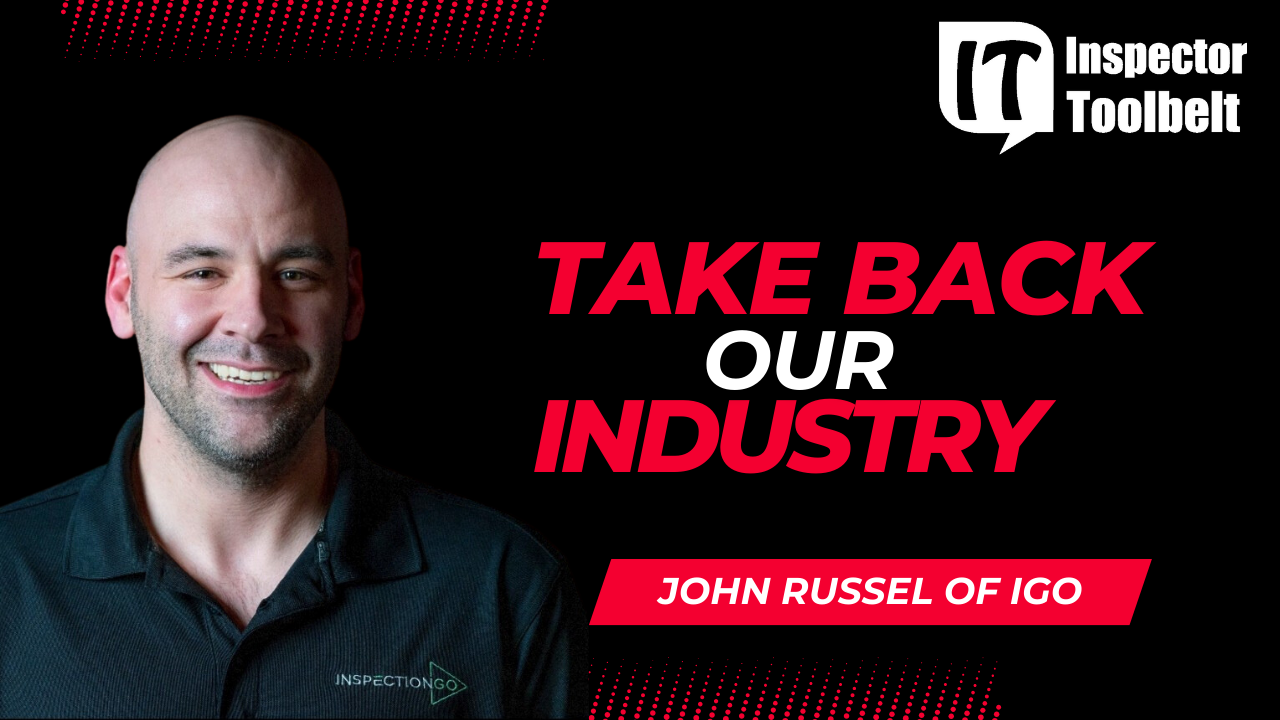
LISTEN IN AS JOHN RUSSELL, CEO AND CO-FOUNDER OF INSPECTION GO TELLS US ALL ABOUT HOW HE AND HIS TEAM ARE SUPPORTING THE HOME INSPECTION INDUSTRY.
FOLLOW OUR PODCAST





PODCAST TRANSCRIPT:
Ian Robertson
Welcome back again to Inspector Toolbelt Talk. Today on we have a special guest, we have John Russell from iGo, how are you, John?
John Russell
Great. How are you?
Ian Robertson
Hey, I’m doing fantastic. You know, we’re privileged to have you on the show. You’re kind of a big dog in the industry. And it’s nice to have you on. You are the CEO and co-founder of iGo. I’m sure you already know that. But maybe you could tell us a little bit about yourself. And what iGo is to kind of get us off the floor and rollin.
John Russell
Yeah, great. Yeah. Again, my name is John Russell. I’m the CEO and co founder of InspectionGo. InspectionGo is focused on helping home inspection companies grow their business. You know, we started a little over three years ago, we acquired Mike Crow’s millionaire inspector community, and Axiom Academy, a school that was under my Axiom inspections out of Denver really brought those together to start supporting home inspection companies, helping them grow, helping them find new inspectors looking to hire, while we’ve been investing and building technology for the industry over the last few years.
Ian Robertson
Yeah, and I’ve been kind of keeping tabs on a lot of the stuff that you guys have going on, you have Keystone, you have a new, I don’t want to call it a product, a new concept with Curbio, and some other really great stuff going on. But what I like about you guys, and the reason we have you on the show is you’re not Porch related, you’re not big business from outside the industry. You’re, you’re inside the industry, right? You’re independently owned.
John Russell
Yeah, independently owned. And, you know, we were, you know, my co founder’s Chad Hett, the founder and CEO of Elite group, one of the largest independent home inspection companies in the country. And when we got started, we saw this opportunity within within the industry that a lot of outsiders see, and are investing money to come into our industry, because of the timing, that we’re coming in contact with new homebuyers. You know, a new homeowner spends more in that first six months than the rest of the homeownership journey combined. So there’s a lot of focus on trying to get to that opportunity. And, you know, Chad Hett and I, years ago, I was actually working with Chad at the Elite Group for a few years helping build the business. And we actually took it from six to 12 million over a short period of time. And through that we started, I started to meet a lot of the other top very influential inspection companies out there. And from there, when we launched InspectionGo, Chad and I, some of our earliest investors are some of the top inspection companies in the industry. You know, when we go to our conferences, you know, I think one of the things you hear across the board is “together we win”, we really believe that, you know, by bringing all the great independent inspection companies together, there’s a lot of things we can accomplish, you know, to, you know, compete against some of those outside forces that exist.
Ian Robertson
And for anybody that doesn’t know, iGo or you guys in general, your name is synonymous with big inspection companies, like Elite Group, even I believe Nick Gromicko is a strategic..
John Russell
Advisor. They’ve got a..
Ian Robertson
Strategic advisor. Yeah, yeah. So I mean, anybody who’s in the inspection industry, who is anybody recognizes the iGo logo, the iGo name. So you guys, you guys are definitely out there. And you know, the Mike Crow and the Axiom thing, I really liked to see that because I think one of the big issues and kind of leads into what we’re going to be talking about today, which is the inspection industry as a whole, and where it’s going, it’s nice to see somebody instituting change from within, because it’d be nice if we took control of our own industry, right, rather than all these other companies coming in and saying, We know how to do this better. Let’s just cut out the inspector, and we’ll make a bunch of money. And that’s not really where we’re…
John Russell
No.
Ian Robertson
As Inspector Toolbelt that’s not where we want to be.
John Russell
No, and you know, in this industry, there’s so many great, as I said, you know, independent home inspection company owners across the country, there’s so many great, you know, there’s great franchise systems with great franchisees, but there is no national brand that’s large enough across the United States to be, you know, the national brand in home inspection. So there are these outside forces that, you know, are coming in trying to consolidate those transactions, you know, and, you know, from our perspective, you know, we believe that rather than have someone buying all the companies or somebody else, buying all the vendors and forcing people to use certain softwares, we believe in building a platform that all the independent inspection companies can, you know, work together to accomplish, you know, lots of different things.
Ian Robertson
Yeah. And that’s what I like to hear independently owned companies taking taking back our industry and that’s kind of our our mantra is take back our industry because to be perfectly honest, let’s break into that discussion. I feel we’ve lost ground in our industry over the past few years, when years ago with the quote unquote, I don’t want to call it the fall of ISN, but the big gut punch to ISN when Porch bought them. The whole big thing with Amfam and Home Gauge, and then Porch bought up a whole bunch of other software companies, including Home Inspector Pro, which at the time was the largest software company, and then you have you have companies that that have come and go, but the latest one is going is going to be Inspectify, which we’ve mentioned on the show. We’ve lost some ground. Yeah. Do you think we can gain it back?
John Russell
Yeah, I definitely think we can gain it back. And when you look at how everybody’s approaching it, you know, Inspectify’s business model is to, you know, be the API for the home. And their path to doing that is to control the booking of the inspection and subcontract it out to home inspectors. So they want to be that brand that everybody thinks of when it’s time to book an inspection. So they control can control the data that’s being collected, and what’s happening with it, you know, and as you said, Porch, buying up some of our vendors and, and forcing, you know, and really, you know, creating programs where, you know, if you trade the lead, you can get the software for free. You know, I think that there is an opportunity for us to take back the industry, when you look at, you know, Inspectify, for example, there’s a reason they’re able to go out there and get agreements, and it’s because they’ve got 1000s of inspectors signed up across the country. So we’re kind of doing to ourselves there where, you know, we all, you know, sign up for a program to get the demand and turn, you know, that company looking for inspections now has a national solution, and, you know, we now are we have a middleman and there. So I think the path for us to take back the industry is, you know, the vision that we have is to really bring those companies together, we do similar things to inspect, like Inspectify, but we don’t cut the home inspector out of the monetization of, you know, the homeowner experience or if that agent wants to come back and work with them again, that’s awesome. Our goal is to help home inspection companies retain that business through our program. And we’re not going after agents and local markets to book through our experience, we’re working with national investors and in business that the local inspectors can’t get on their own and not going after the agents. So I think for us, you know, by having enough of the big inspection companies and really inspection companies of all sizes, working together. You know, one of the things that I saw constantly, when I was working with Chad at Elite Group was opportunities would come to the Elite Group where we could, you know, people were interested in, you know, you know, us referring homeowners for something or, you know, a, they had a need for inspections all over, you know, the West Coast or, and we even at Elite Group couldn’t provide it one of the largest inspection companies in the country, because we just weren’t big enough. So I think by having home inspection companies that are working together, you know, we’re not fighting against each other, you know, we’re fighting against these outside forces. And I think the more friendly we are with our competition, and you know, working together really is that answer.
Ian Robertson
And you know, I think the last part of what you said was very important, we’re fighting against these outside sources. Oftentimes, we’re competing against each other, whether we’re single inspector or multi inspector firm, we tend to compete against each other. And that’s part of the market in general. But these outside forces are taking advantage of that, because they have a lot of resources. And it’s kind of interesting to think about, there’s an old expression that says what one generation tolerates the next generation embraces. I remember 20 years ago, almost starting my first inspection company. And I tried to call a firm about an arrangement. And we were doing pretty well at the time. And he said, I’m sorry, we don’t work with home inspectors, we only work with agents because there’s not enough juice in that fruit with the home inspector. And I looked and they wanted data, and I’m like, Okay, this. So I looked at one of the agents that worked with their entire office sold 100 houses that year. So they only got data, if they got all the agents in that office for 100 houses, for 100 families, they could have had 10 times that with just one inspector in some cases, or five, five or 10 times that I never understood why people didn’t, why outside companies didn’t figure it out sooner, because even then, you know, I didn’t know what to do with that information. But back then it was a different market. But getting back to my point of what one generation tolerates another generation embraces. Newer inspectors don’t realize how much ground we’ve lost. An average inspector doesn’t think how does this affect my daily life? But I look at the metrics from 10 years ago, compared to today, profits are down, the way we do business is down, we’re doing more on an inspection for less, going well outside SOP for half the money. I talked to inspectors all the time, I was just helping this one guy out. He’s doing 500 inspections a year, for $300 an inspection, and he’s just barely getting by. And I’m like, it’s a much different industry now. And you know, it’s kind of shaped like Inspectify, they change all their prices, so they only give the inspector a couple $100. Okay, well, I don’t work for Inspectify. Right? Yeah. But that changes the market’s perception of the value of services. So there could be 10 home inspectors say, oh, they’ll only give me $200. So I’ll charge 300. Now, I’m above that. Yeah, it changes perception, it does affect our daily work. Do you think that’s true?
John Russell
Yeah, no, I definitely think it does. And I think another another angle to look at that, too, is when you look at, you know, the today we do a home inspection. And that’s it, right? Like there’s no relationship continuing with that homeowner. And that’s why the value of a home inspection business is isn’t quite as high as is some other industries say like Pest Control, where you have that reoccurring revenue and that reoccurring customer. So I think that, you know, the industry is changing. And there are, you know, some of these outside forces that are coming in. And the reason that they’re coming in is back to what I said the beginning, homeowners spend more in that first six months than any other time during homeownership. So I know these, all these other companies that are coming into our industry, that’s why they see that, and the person with the keys, the person that owns that relationship, the most important person of that whole thing is the home inspector, it can’t, none of it can happen without you know, the home inspector. So A, the homeowner needs to be the north star, if anything’s being done, there’s the future I believe is home inspection companies are taking that, you know, information that they’re collecting, and giving the homeowner the ability to, you know, use it to make their lives better, right, not to sell it to five different vendors to try to sell them, you know, security and TV and Internet and a million different things. But to truly help out a homeowner. And you know, the only place that that information exists is the home inspection company owners. So I believe that, you know, the future of our industry is home inspection companies are the ones that can really create a customer for life experience, right? Where that property information powers a homeowner experience that’s really valuable, and gives that home inspection company and that agent, the ability to be in front of that homeowner throughout the journey of homeownership by truly providing value. So I think the shift, like things have changed over the last three years, five years where, you know, if we would have said five years ago, anything about contacting homeowners or trying to help them have a better experience, it was unheard of. Right. And thankfully, companies like Porch and others have come in and made that you know, the standard way of doing business, I think that there’s a better consumer experience to be had, and the home inspector is the key without the home inspector, none of it happens. So compensating home inspections fairly, making the homeowner the true north star. And the homeowner data is the homeowner’s. So giving it to the homeowner in a way that they can use it in valuable ways, not selling contact information off to vendors to be reaching out. So I think the changes over the last few years are good because it’s moving us into a world where I believe home inspection company owners, you know, should be getting residual incomes on every homeowner that they’ve worked with. So I think the evolution is a good thing. But it’s just it’s just going to be different than it was before.
Ian Robertson
Yeah. So we’ve used the illustration on the show, before that the wave is coming. Do you fight it? Or do you ride it? But that doesn’t mean we have to ride it like everybody else does. Because in the industry, you brought out a really good point that the homeowner should be the North Star. I like how you put that because data is a dirty word. You know, we talked to inspectors every day and they’re nobody likes to think..
John Russell
I agree.
Ian Robertson
I don’t want to sell my client’s data. I don’t want to sell my client’s data. This is my client’s private data, because especially guys that have been in it 20 years, this is sacred, you know, their homeowners information is deeply sacred.
John Russell
It is, right.
Ian Robertson
So instead of looking at it as data, which is, which is what these other companies are doing, basically, let me get this data and work that data as hard as I can to squeeze out every last dime. Instead, ignore the data and look at the person, it’s the homeowner. Okay, now we have a relationship with them. We are the gatekeeper and we’re not grabbing data out of their person running. We’re meeting them with a warm handshake. That I like. But that’s an unavoidable change. It’s already here. It’s already here. Yeah.
John Russell
Homeowners will have an easy homeowner, the homeowner experience will become easier and less frictionless. When you think about, you know, the younger generations and then being able to maintain a home like it’s, you know, if you take someone that’s in there for 40, 50 years old versus someone that’s 20 years old, you know, they don’t know how to swing a hammer anymore, or do half the things to maintain a home, they’re used to, you know, they want food, and it’s in the evening time, they’re hitting Uber Eats, and it’s showing up on their doorstep, like, things have gotten really easy. And you know, the home the most valuable thing we have, you know, you’re left to reactively deal with things with the home and it’s inevitable, it’s going to change. And the one thing that’s going to that can help homeownership be easier is the property information. And you know, in order and for it to be done the right way, the homeowner needs to be in control, you know, not sharing the information with third parties, so they can mark it at the right time, but giving it to the homeowner, so they can make decisions during that homeownership journey and make that process much easier, which sure there’s monetization opportunities and inspectors should be, you know, compensated for those opportunities the entire time that homeowners part of that for life, customer for life experience. But the key is, that has to be the homeowner, because if the homeowner isn’t happy, the agent isn’t happy. If the agent isn’t happy, they’re not going to use us anymore. So that homeowner experience is so important.
Ian Robertson
Yeah, and it’s funny too, because people do rely on us as home inspectors, I find a lot more than they do like their real estate agent afterwards. Like we get questions all the time completely unrelated to the to the actual home inspection. People are like, Oh, what about this? What about that, you know, you’re always so responsive, and very helpful and gave us good information. But I guess the difference between what I would like to happen, and what’s actually happening in our market is I don’t know, if you’ve been watching the news, Walmart has gotten caught, you know, just basically blatantly taking our data and selling it. They bought these 18 things this day and, you know, they tend to buy more of this kind of cat food than others and they sell that data. That’s how they’re making their money. Nobody likes it, it feels icky. But going back to the real estate agent, I remember I used one to buy my house. And every so often he’s like, hey, what about this? Hey, you know, I was thinking about you, I was thinking about this, I was thinking about that. It’s a much different thing, because he’s not he hasn’t taken my data and just sold it and worked it. It’s a relationship, I would sell my house with him again. And I would call him and say, Hey, what do you recommend for this? Completely different than Walmart selling my data. Yeah. So that’s what I would like to see happen instead of what actually is happening.
John Russell
Agreed, yeah, there’s, there’s a lot of ways that that information can make life easier. Even I mean, you get in your car, and you look down at your phone, and it asks you if you’re driving home, and you click on the button, and next thing, you know, it’s navigating your home, it’s you know, it makes it easier, right? Like, I’m not mad because my phone knows where my house is, and that I usually leave the office at the same time. And it’s figured out, Hey, you’re probably going home. Right? So that’s the same type of thing, right? Like, I’m, you know, using that property information, to create experiences for that homeowner to leverage and not share any other personal information. That’s, that’s the future. But, you know, you know, there’s definitely other ways that, you know, this is being approached out there, you know, we really believe that, you know, taking, you know, if you do 100 inspections last month, and you know, next thing you know, ABT or TV and Internet company, or a plumbing company is just cold calling those homeowners that coming back to you like the agent is, it’s not a good experience, in my opinion, the experience that needs to be there is really arming that homeowner with the information and letting them make those decisions. You know, it’s crazy. Today, home inspectors, you know, they go out, they do a home inspection, it’s used to negotiate the price of the home, put in a drawer and never used again. And like your work is so much more valuable than that, like so much more valuable that that homeowner should be able to get so much more value out of the data and information you collected about their property than to just put it in a drawer and not not to be remembered. So, you know, that’s where we really think like the the change, the future, is that that inspection report becomes much, much more valuable to that homeowner than just that one moment in time.
Ian Robertson
Yeah. So you’re speaking my language in the fact that two things, keeping the data with the homeowner and keeping them in control, because I hear that a lot. I mean, matter of fact, after some podcasts like this, I’ll get emails and messages from inspectors saying, Well, I’d never give out my clients’ data. It’s getting given out whether we realize it or not. Most of the time, it’s just a matter of what software we use what we’re what we’re doing. and how we send the information, whatever. But like you said, you look down at your phone. And they know, your phone knows where you live. That’s the, that’s the fact of life now. So the change has already happened, will we do it the right way? Will we allow the outside industry to take over?
John Russell
Those outside forces will force it to be done their way or, you know, and that’s where we can take control and do it the right way.
Ian Robertson
Yeah, exactly. I want to do it the right way, because it’s already happening. The second thing you talked about was residual income. I have helped so many home inspectors get ready to retire. And you know, just guys that I know, might go, hey, you know, find a guy, see if you can sell your business or something. But almost invariably, they end up selling their business for like, five grand, I remember this one guy, he had like six inspectors, relatively busy, he goes to sell his business. And he’s like, I’m gonna sell it for, you know, $800,000. And I’m like, No, you’re not. And I said, you’re probably gonna sell for. I said, like five to 10. So six months later, he calls me and he’s like, Well, he called me a bunch of times. But he’s, he’s like, the only offer I got was five grand. And that was just for my website and my past client data. He’s like, I can’t believe it. I’m like, because once you’re gone, now, they it’s a dead, it’s a dead end service. And not, I always say it the wrong way. There’s actually another term for it. Dead end service as in, we complete the service. And then it’s done. There’s nothing recurring. So it’s not like you’re an accountant that has somebody that comes back every year. And you can pretty much count on 90% of them coming back every year. So there’s recurring income, that makes a tax business very sellable. But it makes a home inspection business very unsellable.
John Russell
Yeah, yeah. And it really comes down to two things, right? When you’re looking at selling a business, it’s how much money do you make every year, what your profit was, and then, you know, what’s the multiple, right, and if you’re a business, that’s transactional, and you’re collecting an inspection fee, and then you don’t have any other relationship with that homeowner, the multiple on your, you know, EBIT is going to be much lower, you know, whereas if you, you know, look at a pest control company, a lot of home inspection companies build a pest control company beside it, you know, I don’t know that, that makes sense for everybody. But you know, it’s happening. And the reason that they’re doing is because that pest control, revenue is a reoccurring business. So they’re using the home inspection business to get the client for pest control. And then building a residual business, we believe that, you know, pest control is a great example, right, like a home inspection company could have a partnership with a pest control business that creates a residual income stream, homeowners insurance, right, like normally, when somebody gets their homeowners insurance, every year, they’re renewing it at 80, 90%. If you’re in a concierge program, and they’re selling insurance, or you’re not getting a residual income, you know, then you’re not making money on the book of business you’re building. So that’s where, you know, we really believe that, you know, whether it be homeowner warranty, or insurance or you know, pest control, I mean, there’s many, many, many categories that if you truly treat the customer the right way, right, like give them the information, make them the North star. They’re gonna, like if we’re trying to create a customer for life, you have to make the experience, you know, world class during that and make the customer the North star, if you want them to continue to come back and to have those residual income opportunities, it really requires to, you know, not just take the property information and make and make as much as we can during the, you know, move in process. It’s about building a customer for life, because of all those residual income opportunities, which, you know, the more of that, that an inspection company can have, it’s going to increase that, you know, multiple that they’re getting on their business if they want to sell it.
Ian Robertson
Yeah. And you know, it’s interesting that you mentioned like homeowners insurance, and some some other types of things like the pest control thing that what a lot home inspectors do, they start another business, we interviewed a guy a few weeks ago, and he does mold remediation and crawlspace encapsulation and radon and things like that if your state allows it with your SOP, cool, pest inspections, and are not part of a home inspection pest company that works out perfectly. But those are all completely different companies. So now you have to have and maintain 2, 3, 4 different companies to be able to get that residual income and then it’s still working to have employees. So you mentioned things like a concierge or homeowners insurance and things like that. I do have to say I can feel some of our listeners cringing because you know what it’s like, there’s a restaurant down the road for me that I went to. I had a really bad meal, and I just never went back and they may have just could have just been the cook that day. Or it could be the restaurant but I’ll never order that meal again because I’m like, Man, that’s gross. I never go back to the restaurant never got that meal again. So we’ve had a lot of people try that in the industry. But they’ve made a lot of bad meals, because they went about it the way that an outsider does. Let me just work this lead, you want, I’m gonna get this person to buy homeowners insurance, whether they like it or not, you know, 30 phone calls, emails and follow up. So for a lot of us in the industry, we feel burnt on it. Yeah. So when we hear that, it’s like, yeah, okay, it’s another attempt at this. What with iGo gives you guys the difference? How do you make the homeowner the North Star in that situation, as you put it?
John Russell
Yeah, you know, a lot of the programs in the past are all focused on, you know, making as much money off of the homeowner in that moving process, right? A lot of companies are very willing to buy lists of leads, whether it be security companies or, you know, repair companies where they can start calling that homeowner sooner, and at iGo like we we really believe that in order to give that customer for life experience that we envision, where we’re helping that homeowner and providing value to that homeowner together with inspection company throughout the journey of homeownership, the only way to get there is to truly provide a valuable service at move. Right. So it’s not about how much homeowners insurance, can we sell that person? Or what’s the contract conversion rate for security? It’s how do we, you know, provide a valuable service to you know, homebuyers that need it. ones that don’t need it, they don’t ever get another phone call, again, we’re not selling the information to five different places, and having five different people reach out to the customer, they have one point of contact, you know, a home expert from Home Binder that they can reach out to that has the ability to help them with all the services, you know, if if we reach out to that customer twice, and we don’t hear back from them, you know, we’re done right? Like we’re not hitting, you know, reaching out to that customer 8, 10 times to try to get them on the phone to sell them homeowners insurance, our vision is to have a relationship with that customer through the entire journey of homeownership. So it’s not a you know, sell as much as we can in that first phase irrelevant to the experience. No, it’s very, very much we have these services, how can we help and you know, a lot of customers are already working on on their own and don’t need any help. So, you know, once we hear that once, they don’t get four more phone calls from different companies that bought the lead as well, because that’s it, as soon as we find out that they’re working on it on their own, you know, we move on. So we’re very focused on the customer for life, which means we need to give a great experience during the during every interaction with the homeowner.
Ian Robertson
Yeah, and that’s and that’s the that’s a good answer. It’s not data driven. It’s client driven, right? Or the homeowner driven. So I see the difference between your model and their model is their model is when you walk through the mall in the food court. And you have like all these food vendors just like shoving food, saying, hey, grabb this, giving you know, giving out all those free samples. You guys are the sit down restaurant where the customer comes in, looks at the menu and places an order.
John Russell
Yep, exactly. Yeah.
Ian Robertson
Yeah, both scenarios have data on you. But the one is you’re taking the order. What can we help you with? Do you even want help? Yeah. So that I like, that’s good. And it doesn’t get sold or transferred anywhere that, that’s what’s key. And Home Binder has a good reputation Home Binder has been met. Jack Huntress from Home Binder. I’ve known him for I was one of their first clients when they actually came out. Yeah, when they first came out. I’m like, I’ll experiment with them. We’ll see what happens. Yeah.
John Russell
He’s a great guy. You won’t find anybody that keeps that homeowner as the North Star more than him. That’s actually, you know, we’ve always made the homeowner our top focus. But the whole, you know, homeowner’s the North Star came from Home Binder, it’s been their, you know, their guiding light the whole time they’ve been in business. And, you know, up until now, right, like if you sign up with Home Binder, and you know, you can use Home Binder today and none of that information is shared, nobody’s reaching out to any of the client’s Home Binder Assistant is an additional program that we’ve put together since, you know, acquiring Home Binder Repair Pricer here a few months ago, but the standard version Home Binder always has been, you know, zero communication with that homeowner, from third parties to sell them things. So Home Binder Assistant is a program that we’ve launched that, you know, as I said many times here, it’s focused on that one point of contact for that homeowner and trying to truly provide a valuable service during the move in process to build that customer for life rate relationship with them.
Ian Robertson
Yeah, and if you don’t mind, just a couple things that I really liked what you guys are doing because I don’t have just anybody on the show and say, Hey, I like what you’re doing. I don’t know all the inner workings of what you guys have. So there may be parts that I don’t like. But for the most part, what I like is you guys are within our industry. And when I watched, I saw the article come up about when Home Binder and Repair Pricer were purchased and my heart dropped. I’m like, another one bites the dust. Here we go again. And I’m like, iGo, Oh, that I’m okay with because that’s independently owned, inspector run, and I’m okay with that. If there’s going to be a wave hitting the beach, I’d rather be our own wave than an outside one. Yeah, but you guys also have Keystone going on.
John Russell
Yeah. And I, backing up a second to the repair pricer and the Home Binder acquisitions.
Ian Robertson
Yeah.
John Russell
We acquired them in an all stock transaction was zero cash, both companies are worth plenty of money to these other outside groups that are buying vendors right now. You know, but the reason that we were able to acquire them for stock and zero cash is because we all three have the same vision, if you’ve worked with any of the three companies, one thing you know, is our relationship with home inspection companies is like our main focus, right, ensuring that that homeowner experience and their property information is, you know, kept secure, is you know, so I think all three companies had the same vision of creating a better way to you know, join in, in this opportunity around helping the homeowner with some of these tough things that they need to do. And, you know, not do it the way that others are doing it today. So all three companies have the same vision. And when you bring us all together just helps us move a lot faster. So I think it’s really important to mention that like, nobody got a big check, not some big private equity money that came in to write checks to you know, cash everybody out, every everybody doubled down for, you know, creating a, you know, continuing to help the home inspection industry protect itself from some of these other opportunities out there by doing it the right way.
Ian Robertson
See, I didn’t know that. That’s interesting. There was no, no cash in hand on that deal. Interesting. It was it was big in my eyes, like, you know, again, for the average home inspector, sometimes we drive around in our truck going to the next inspection without thinking about these things. But that was taking back some some of our footing, in my opinion, you know, because they could have easily been bought up by somebody else.
John Russell
Nope. Very easily. Yeah. And I mean, great products, both of them Repair Pricer has been growing rapidly over the last two years, continuing to, you know, evolve their, you know, cost estimates to be more and more and more accurate, trusted by, you know, millions over the years. So, you know, definitely really lucky to, you know, be able to bring them on and both Christian, the founder of Repair Pricer and Jack at Home Binder, culturally, we are very aligned around how we see the industry and how we, you know, want to partner with home inspection companies.
Ian Robertson
Yeah. And I’d like both those guys. Christian has been on the show a couple of times, both before being acquired and after, and just our private conversations before or after the show makes me feel more comfortable having them on because I’m very careful. Yeah. Who do I have on here? Is it going to be beneficial for our industry? Or is this something that is going to feed the beast that’s consuming us? And I’ve always felt great about about Christian and Jack. And now, you. So tell me a little bit about about your scheduling software? I’d love to hear some more about that. Yeah, because that, just to add on to my own question here, which you shouldn’t do. But it’s interesting, because there’s not many choices for large scale admin software. So Inspector Toolbelt, we have scheduling software, but it’s not large scale admin software, you have other large scale admin software that has just been gobbled up. So if you are working with it, you don’t really have much of a choice and it gets your data gets processed one way or the other to a big company. So tell me about your guys’ large scale admin software.
John Russell
Yeah, so Keystone is our you know, is our, is our product. And, you know, I think the some of our competitors, most of our competitors. If we look at how much the industry has changed over the years, they were created when the industry was much different than it is today. Right? You know, so, you know, we had the advantage of starting from scratch three years ago and building what, building to the future of the industry versus starting with something that was built for, you know, an industry that is significantly changed. So some of the features within it are, you know, when you go into book an inspection, and you put in the property address, we have MLS integration in the majority the United States, so it’ll instantly pull over the square footage and the year built and the photos and everything from the MLS to speed up that process of of getting the right information into the system. Also, we have drive time analysis built in. So when you’re going to pick which inspector could go do which job, it’s going to tell you how far it was from their house, how far it was, from their last job, how far it is from their next job, you know, we really, really focused on building a digital, you know, booking experience for inspection companies, that can be, you know, very, very quick and in order to have your agents have the ability to not call to book the inspection, but use, you know, the the digital booking tools, they need to have a lot of information, they need to know a lot about all your inspectors, they need to have information about the property, and then information about the services you offer. So we spent a lot of time making Keystone very, very, very intelligent, so that when you’re booking with our digital booking tools, it can be done in just a few clicks, versus you know, having to enter all the information about the home, you know, ours will pull it over from the MLS and build the pricing right away, it’ll only show the inspectors that are qualified to do those type of inspections in those areas. So really, really spend a lot of time understanding, you know, that 11, 12 minute phone call that comes in to book an inspection, and how can we cut the time back so that the agents or the buyer don’t have to spend that much time on the phone, and also cut back on the errors that are happening, and we’re actually capturing all the information. So you know, we’ve got a call center, that’s booking 1000s of inspections a month for inspection companies. So we have the ability to really study what’s happening during that booking process, and how can we really optimize it. So when we get into that digital experience where our customers have, you know, this world class tool to book inspections, that it’s seamless, and simple for them to do that. So you know, you know, invested heavily around building a system that’s really intelligent, because the smarter it is, the more capabilities it has to do things in the future.
Ian Robertson
That’s awesome. I just wanted to make sure that we mentioned Keystone in this podcast, because what I want everyone to know is we’re not fighting it alone. It’s not like you’re driving in your truck right now listening to me and John talk saying, Okay, well, what am I going to do? There are others that recognize that our industry is being invaded. And we want to take it back. And that’s been kind of my soapbox, my, my platform, is takeback our industry. So anybody that’s going to help us take that back from the inside, I love to talk to them. And John, you’ve been very helpful. I’m really anxious to see when Keystone gets fully released, when all your other programs are fully out there, and what you already have going on, really anxious to see how it all plays out. And I really appreciate you being on the show.
John Russell
Yeah, thank you very much. It’s been great and great to get to know you as well. Same on our end, you know, the more people and more, you know, companies that are pushing, you know, from the inside, the better. So it’s really, really been really great to meet you.
Ian Robertson
Yeah, same here. Hopefully we’ll have you on again soon. But thanks again for being on.
John Russell
Yeah, thank you.
Outro: On behalf of myself, Ian, and the entire ITB team, thank you for listening to this episode of inspector toolbelt talk. We also love hearing your feedback, so please drop us a line at [email protected].
If you’re enjoying the conversation, don’t forget to hit the subscribe button. Our podcast is available on all major podcast platforms. For more information on our services and our brand-new inspection app, please visit our website at Inspectortoolbelt.com.
*The views and opinions expressed in this podcast, and the guests on it, do not necessarily reflect the views and opinions of Inspector Toolbelt and its associates.