
The History of the Fire Alarm System
Did you know where the fire alarm system started? Here’s an interesting article about where it began and how the fire alarm system has evolved since then.
It started with a community.
As communities are organized, preventive measures must be implemented for safety and protection. Fire alarms were created to keep the community warned to be safe and well at its simplest form.
The need for fire alarm systems is universally understood since it has a significant role in protecting infrastructure, livelihood, and life worldwide with a simple warning.
Fire Alarm Systems Evolution
The Ancient Greeks and Romans set the first fire alarm system standards: the primary method is applying water to fire. Creating a fire-extinguisher and pump is the prototype of our fire alarms today.
That’s not exactly how we see fire alarms today, but we just have to remember where it started.
Technology has significantly advanced, but the necessity to warn people of the fire remains the same. More measures like fire-fighting equipment, fire stations, and fire trucks were implemented.
Bell Towers: The First Fire Alarm System
Since the 16th century and within most civilizations, keeping the water supply close or accessible in case of a fire has been necessary. Eventually, larger communities needed better ways to reach and warn people because of distance. That’s when bell towers were used as the first fire alarm system.
Bell towers are built to track time and rung for town gatherings and church. The difference is you will hear a different sound if it’s a fire warning.
In 1828, Pennsylvania State House rebuilt its independence hall a new tower. A tower with a new bell and an official watchman. Franklin Peale thought of specific bell-ringing signals. The bell is rung at different intervals to alert people where the fire was to head in that direction and bring water.
This method has been implemented in other big cities as well. Bell codes are beneficial, but as time goes by, they’ve realized more precise ways of locating the fire before it reaches a harmful level. Fire alarm systems have been upgraded since the bell tower.
The Official Invention of the Fire Alarm System Box
The mid-17th century was an era of life-changing inventions.
After Samuel Morse invented the telegraph in 1837, Mr William F. Channing of Boston, MA, created the first official fire alarm system.
William Channing and his assistant Moses Farmer thought that telegraphy and electromagnetism were valuable tools to communicate despite the distance and location, specifically for emergencies. The primary goal is to alert firefighters to the exact location of a fire as it started.
Old fire alarm systems were a bit complicated since they had many components like metal handles, wires, levers, and more. In 1852 the process started with someone cranking the handle to alert the nearest fire station and at the same time a warning of the fire’s location.
If you turned the fire alarm’s crank too fast, telegraph signals would not be sent out.
The release of the alarm’s bell clappers needs to be precise as it is very sensitive. Typically, you might get scared in an emergency, but you still have to ensure that you crank the handle correctly.
The invention was a monumental moment for a busy city. Improving the city-wide safety protocol was patented immediately. The patent for “Electromagnetic Fire Alarm Telegraph” by Channing and Farmer was released on May 19th, 1857.
Modern Fire Alarm Systems
Channing set out his proposal in March of 1855 at the Smithsonian Institution lecture in Boston, Massachusetts. He said that his invention was a higher system that needed to be adopted. Unfortunately, his product was not gaining popularity, and he was going into debt.
A postmaster and the telegraph operator from Camden, South Carolina, John Nelson Gamewell, who attended the same lecture Channing, saw the invention’s potential.
John Nelson bought the rights for the fire alarm box by Channing and Farmer. Gamewell adapted the same firebox design and sold it to over 500 cities. The complicated pulleys and levers arranged on Channing’s initial design are now recognized as “pull-down levers”.
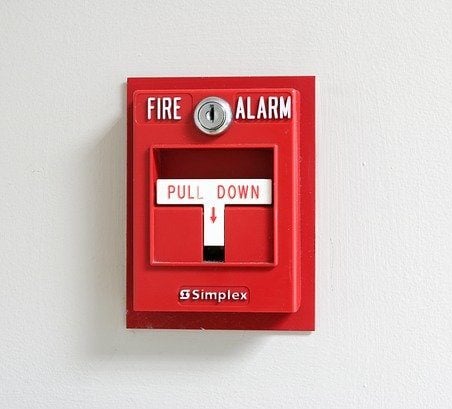
A small red box with a handle that is pulled in case of fire is our general fire alarm today. The initial design wasn’t that different, but Gamewell’s adaptations fixed the complicated things and have been adopted.
From ancient times to the modern-day fire alarm system, you’ve seen how innovation upgraded traditional things to adapt to the modern world.
Choose Inspector Toolbelt for your Fire Suppression System Inspection Software